
Our Daily Bread...
Corpus Christi and the nourishment men need

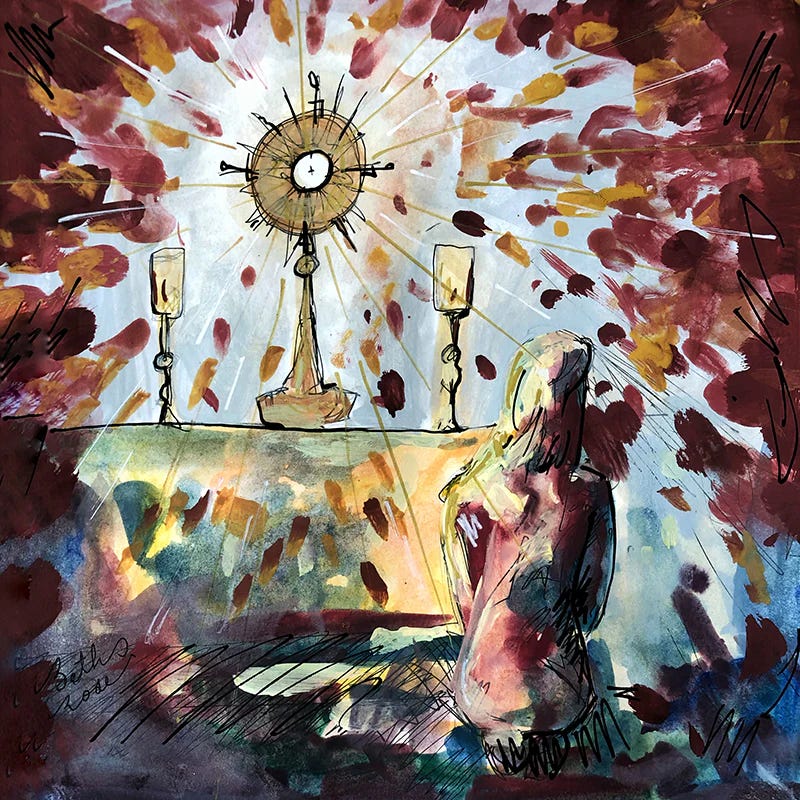
Corpus Christi is the feast of the Body of Christ, the host lifted high, the monstrance carried through the streets, the hymn that sings of a God become nourishment for the hungry soul. Bread is no longer only bread. Wine is no longer only wine. Christ gives himself not as theology or moral principle, but as food. This is my body. The Church has spent centuries meditating upon the full force of that sentence, developing doctrines and liturgical music around it, processing through the streets and kneeling on stone floors, and teaching children to fold their hands before they could even possibly understand transubstantiation. And still we can miss what I think is most central to this mystery… what God thinks of bodies.
So many men have been trained to live as if their bodies were machines, their emotions liabilities, their pain an inconvenience, and their need for love something to manage in private and in silence. We learn to assess our bodies for their usefulness: how hard they can work, how little sleep they can survive on, how much stress they can absorb before something gives way. We learn to present them as proof of strength, competence, desirability, and discipline. Some, unfortunately, may learn to punish them, numb them, or hide inside them like a locked room.
Christianity begins with a splendid contradiction to all of that: the Word became flesh. Not appeared to be flesh, not borrowed flesh as a costume, not tolerated it temporarily — became flesh, and dwelt among us. God had skin, hunger, and a nervous system. God needed sleep, was held by his mother, learned to walk, worked with his hands, got tired, wept at a grave, sweated blood in a garden, was wounded, and died. In the Resurrection, he did not discard the body like a spent shell. The risen Christ still bore his wounds. The body was not erased; it was glorified.
This feast day brings all of this to the altar and then (sometimes) into the street. It reminds us that the Incarnation was never a brief detour in God’s otherwise spiritual project; instead, it is the very revelation of who God is and how God saves. God saves not by floating above human vulnerability but by entering it so completely that even bread becomes the place where divine love gives itself away. That is good news for everyone. But it may be even better news for men who have forgotten they are allowed to be human.
God does not save what he despises
There is an old principle, often attributed to Gregory of Nazianzus: “That which he has not assumed he has not healed.” He was arguing against the heresy of Apollinarianism, which held that Christ had a human body but a divine mind. (Let’s not get bogged down in 4th-century Christological debates, though.) The bottom line is this: Christ saves human life by taking it into himself, healing our nature not from the outside, but by entering it. He assumes the fullness of our humanity so that it can be redeemed. This is a profound and necessary claim for anyone who has been taught to distrust part of himself.
Most men are not directly taught to hate their full selves; the lesson is subtler. Boys learn which parts of themselves are welcome and which must go underground. Anger is often permitted, even rewarded; competitiveness is encouraged; toughness is admired. But sadness, fear, tenderness, loneliness, shame, and need are often treated as defects in the masculine operating system. Boys learn early that some feelings are allowed and others will cost them, that tears can become jokes and vulnerability can become ammunition. So they adapt and become experts in the art of self-disguise.
Depression shows up as irritability. Anxiety becomes control. Loneliness turns into sarcasm, shame into contempt, fear into anger, and exhaustion into numbness. The wound does not disappear; it simply changes its appearance. This is part of why men’s mental health is so hard to get a handle on, even for men themselves. A man rarely says, “I am depressed.” He says, “I’m fine,” while withdrawing from everyone who loves him. He doesn’t say, “I am anxious”; he becomes rigid, hypercritical, and unable to stop working. He doesn’t say, “I am lonely”; he says people are idiots and retreats into a private world of screens and resentment. The tragedy is not just that men suffer, but that so many suffer in translation: their pain is forced through the narrow channels masculinity permits until even they no longer recognize it as pain.
Corpus Christi speaks to this with welcome tenderness. God does not meet us as disembodied souls, detached from our wounds and aches. God meets us in the body. He feeds us through the body, healing us through touch, taste, and presence. The Eucharist is not an escape from embodiment; it is embodied grace. You receive it with a mouth and hands and hunger, carrying whatever grief and shame you brought into church that morning. Empty hands, open mouth, amen. There is something beautifully honest about that. The man whose life is neatly arranged and the man barely making it through the week receive the same Christ; the father who feels he is failing, the husband whose anger is really untreated sadness, the young man who cannot admit he is lonely. All come hungry, and Christ does not recoil at the sight of us. God is never disgusted by our brokenness or our scars.
The body keeps the score…
One of the philosophical shortcomings of Western society is our Cartesian insistence on a dualistic view of the person. We often speak of mental health as if it occurs apart from the body, in our thoughts, feelings, and mindsets. Anyone who has lived with anxiety or depression knows the body is never incidental. Anxiety sits in the chest, grief in the throat, shame in the stomach, and stress in the jaw. Depression makes the limbs heavy; loneliness becomes exhaustion; fear keeps the whole body braced for imagined threats. The body remembers what the mind tries to outrun.
This is especially hard for men who have been trained to override their bodies’ signals. Push through. Walk it off. Tough it out. Don’t need rest, don’t admit pain, don’t go to the doctor, don’t talk about it. So the body starts speaking louder: headaches, sleeplessness, drinking too much, scrolling too long, snapping at people, disappearing into work, the garage, or the phone, and finally into oneself. The body confesses long before our mouths are ready to.
The feast invites us to take our bodies seriously because God does. The host is not an idea about nourishment; it is food. The Mass is not a TED talk with candles; it is embodied participation: standing, kneeling, bowing, processing, singing, eating, drinking, and being sent forth. Catholic worship should never allow faith to become purely internal because human beings are not purely internal. We are bodies, and that is not a problem to be solved but a truth to be received.
None of this replaces therapy, medication, friendship, exercise, sleep, or honest conversation, and we should say so plainly. Grace does not insult the ordinary means of healing. If anything, the Incarnation should make Christians more respectful of them, not less: if God works through matter, we should not be shocked that healing comes through a therapist’s office, a prescription, a walk with a friend, a recovery meeting, a long-overdue conversation, or the humility to say “I am not okay.” The sacramental imagination does not shrink the world; it deepens it, teaching us to look for grace in places we might dismiss as too ordinary, such as bread, wine, water, and oil, as well as in a text that asks “can we talk?”, a friend who stays close, a doctor who asks the right questions, and a wife who says, “I know you keep saying you’re fine, but I don’t think you are.” The Body of Christ keeps offering mercy to bodies that have forgotten how to receive it.
A feast against isolation
One of the cruelest lies men inherit is the idea that needing others makes them look weak. It starts early: Be independent. Handle it. Don’t be needy, don’t burden people, don’t let anyone see you struggle. Some of those lessons come disguised as maturity. Adults do need to learn resilience, and not every feeling requires public sharing. But there is a difference between resilience and isolation, between emotional discipline and emotional imprisonment, and between not making every feeling everyone’s problem and never letting anyone know you are in pain. Many men mistake solitude for strength when it is really just plain loneliness.
The Eucharist is God’s answer to isolation, not merely because it gathers people in a church, but because it is communion. It joins us to Christ and, therefore, to one another. We, though many, are one body, for we all partake of the one bread. That is not a figure of speech but a claim about reality. At the altar, the separate self is not destroyed; it is healed of the illusion that it can exist alone. I am not saved as an isolated unit. I am drawn into a body, and because I belong to Christ, I belong, in some mysterious and demanding way, to the entire body of Christ.
That is beautiful and challenging at once. Communion means my life is not only mine, but that the suffering of others is not unrelated to me. I cannot receive the Body of Christ while remaining indifferent to my neighbor’s loneliness or to the quiet collapse of the man three pews away, who looks fine because men are very good at looking fine. We need to do a better job of creating communities where a man does not have to nearly collapse in a heap before anyone asks how he is. This means asking better questions. “How’s work?” and “Keeping busy?” are fine, but men have learned to answer them without revealing anything. We need questions that gently make room for truth: “How have you really been?” “What’s been weighing on you?” “Are you lonely?” ” Is there something you’re struggling to handle alone?” We don’t need to become therapists, but all of us can practice empathy. Corpus Christi should be a catalyst to form communities of serious fellowship.
The permission to be ordinary
At the risk of sounding scandalous, here’s another Christological truth: the Incarnation gives us permission to be ordinary.
It sounds scandalous because we live in a culture obsessed with metrics and exceptionalism. Men, especially young men, are told to optimize, dominate, monetize, build a brand, get ahead, never settle, never be average. It’s as though we live in a contemporary Lake Wobegon where being average is synonymous with failure. The result is not rising levels of “greatness.” Most often, it is despair, because most of life is ordinary. Most love, most holiness, most fatherhood, teaching, friendship, and fidelity happen in small acts repeated over time without anyone making a fuss.
The Word became flesh not as a celebrity, an emperor, or a conquering hero. Christ spent most of his earthly life in hiddenness: growing up in a simple family, learning a simple trade, living in a place people dismissed, and entering the slow rhythms of eating, sleeping, working, and waiting. I have always found the “hidden years” of Jesus a real mercy. They tell us God is not averse to the ordinary. Corpus Christi extends that mercy, because bread is among the most ordinary things in the world, not rare or impressive, and this is what Christ chooses—to be our daily bread. Glory does not have to arrive as spectacle. Sometimes it is hidden under the appearance of what we overlook precisely because it is common.
This should be good news for men who feel crushed by the demand to “make it” as a prerequisite of having worth. You do not have to be exceptional to be loved by God. You do not have to turn your life into a performance of mastery or to have a five-year plan or a vision board for spiritual and financial dominance. You are allowed to be human, unfinished, and in need of daily bread. Of course, Christ calls us to holiness, courage, sacrifice, justice, mercy, and love. But holiness is not self-optimization, and flourishing is not constant self-improvement. Sometimes the holiest thing a man can do is sleep, or tell the truth, or make the appointment, or apologize, or eat dinner with his family without checking his phone, or pray badly but honestly, or let himself be loved without earning it. The Incarnation dignifies the ordinary conditions of human life, and Corpus Christi places that dignity in our hands. This is my body, given for you… not because you are impressive, but because you are loved.
Becoming what we receive
The danger with any feast is that we admire it as a spectacle without letting it work on us. Corpus Christi can become beautiful pageantry and nothing more; we can polish the monstrance, plan the procession, sing the hymns, and still adore the Body of Christ while remaining strangely indifferent to the bodies around us, including our own. The Eucharist is not only an object of devotion. It is a form of life; an invitation into Christ’s own pattern: taken, blessed, broken, given.
This is not a romanticization of suffering. Men do not need more pressure to suffer quietly for everyone else and call it virtue; too many already do. Christian self-gift is not self-erasure. Jesus gives himself freely from the fullness of divine love, yet he also withdraws to pray, receives care from others, shares meals, forms friendships, and cries out in anguish. Jesus’ full humanity matters. A Eucharistic vision of manhood teaches us to receive love so we can give it, because sacrifice without communion devolves into resentment. Men do not need a spirituality that baptizes burnout. They need one that makes them whole enough to give themselves truthfully. A father becomes Eucharistic when his presence makes his children feel safe rather than frightened. A husband becomes Eucharistic when he listens without defensiveness and loves without keeping score. A teacher becomes Eucharistic when he challenges his classroom without humiliating them. A friend becomes Eucharistic when he refuses to let another man disappear behind I’m fine. A young man becomes Eucharistic when he trades the counterfeit strength of contempt for the harder strength of honesty, courage, and joy.
This is not woke theology. It may be the hardest thing in the world to become a man whose presence gives life. Corpus Christi does not ask men to be less strong; it asks them to understand strength differently. Strength is not the absence of need but the capacity to love in truth. Christ is the strongest man who ever lived because he is the freest: free enough to weep, to touch, to forgive, to suffer without hatred, to give himself away, and still free enough to rise.
Corpus Christi is the feast of Christ’s continued yes to the body. In a world that despises weak bodies, Christ gives his. In a culture that tells men to hide their pain, Christ shows his wounds. In a society that isolates the suffering, Christ creates communion. To men exhausted from performing invulnerability, he comes as humble, ordinary, breakable, nourishing bread.
This feast asks the Church if we believe what we claim. If the Eucharist is truly the Body of Christ, then bodies matter; all bodies, their sleep, their grief, their loneliness, their anxiety and depression, their hunger for friendship and purpose and forgiveness and God. Men, of course, do not matter more than anyone else, but men are too often tempted to forget they matter at all unless they are useful. The feast tells a different story. Before you produce, you are loved. Before you perform, you are fed. Before you prove yourself, you are received. Before you can give yourself away, Christ gives himself to you.
So let the incense rise and the bells ring, and the monstrance be lifted. Let the procession move through the streets, past houses full of hidden burdens, past men who do not know how tired they are, past boys already learning which parts of themselves to bury, past fathers carrying quiet fear and husbands who cannot find the words, and old men who miss being needed and young men who think loneliness is a personal failure. Let the Body of Christ pass by every single body that has forgotten its dignity. And let the Church say with its whole life what the feast proclaims at the altar: God is not ashamed of flesh. God is not disgusted by need. God is not absent from pain. God is not waiting for us to become invulnerable before he loves us.
The Word became flesh. The bread becomes Body. The wounded become members of Christ. and those who were taught to disappear inside themselves are invited, gently and truthfully, back into communion.
John, a thoughtful, thought-provoking essay. To me, what ties you entire message together is where you write: “The Mass is not a TED talk with candles; it is embodied participation: standing, kneeling, bowing, processing, singing, eating, drinking, and being sent forth.”
Understanding the truth of the Mass, seeing it not as a repetitive ritual, but as the Supper of the Lamb, and grasping the profound message of the liturgy of the Mass, from the Readings to the individual prayers, which change day to day, and week to week is what transforms both men and women. I have been thinking about this because of Pope Leo’s recent commentary on the Vatican II document Sacrosanctum Concilium (Constitution on the Sacred Liturgy), which he delivered in three audiences (May 20, May 27, June 3). Pope Leo XVI wrote:
It is true that the action of the Church is not limited to the liturgy alone; however, all her activity (preaching, service to the poor, the accompaniment of human realities) converges towards this “summit”. Conversely, the liturgy sustains the faithful by immersing them ever and anew in the Pasch of the Lord and, thus, through the proclamation of the Word, the celebration of the sacraments and communal prayer, they are refreshed, encouraged and renewed in their commitment to faith and in their mission. In other words, the participation of the faithful in the liturgical action is at once “internal” and “external”.
Encouraging boys and men to not only attend at least Sunday Mass if not more often, but to meditate on the Readings and Prayers of each Mass they attend, can go a long way toward addresses the issues you so rightly raise.
Reading this reminded me of what Mister Rogers said. His goal was to show people at a young age that feelings are human; that anything human is mentionable; that anything mentionable is manageable. He believed that success in this would do a great good for mental health.
You’ve made some points that I myself need to know, to learn, to internalize. Thank you, and God bless you.